
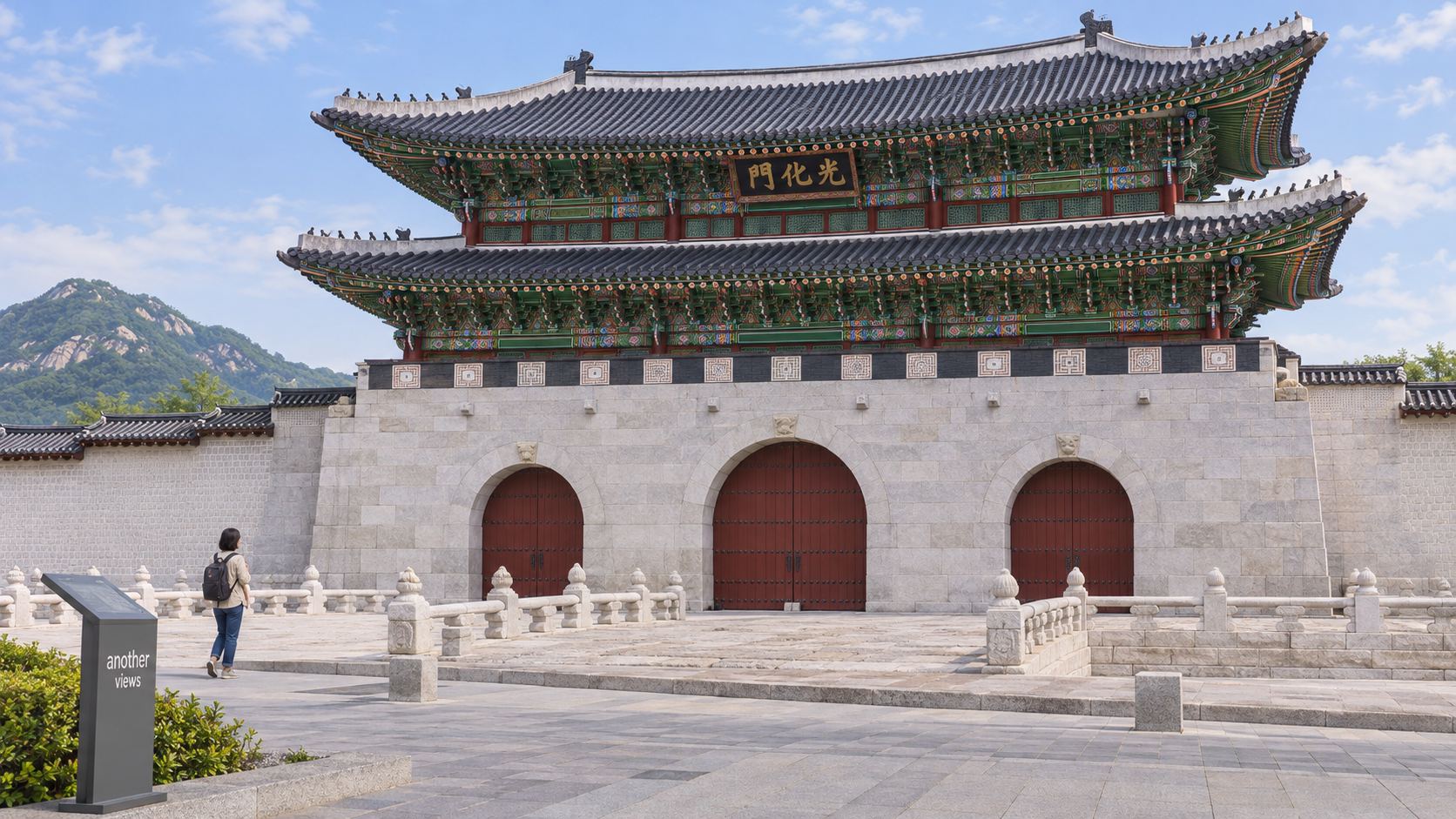
Walk through Gwanghwamun Gate at Gyeongbokgung Palace and into the courtyard in front of Geunjeongjeon Hall. The roof draws your eye first. Then look down. Low stones line both sides of the central path. They marked where court officials stood according to rank. Once you notice them, the courtyard begins to tell you how the Joseon court worked.
If you have time for one palace on your first trip to Seoul, Gyeongbokgung is a good place to start. Choose Changdeokgung if you are drawn to gardens and want to see how buildings fit into a wooded hillside. If your day fills up and you can only go in the evening, try Deoksugung. Each of Seoul’s five palaces offers a different way to see the city’s history.
Gyeongbokgung: Read the courtyard before you look up
Founded in 1395, Gyeongbokgung was the main palace of the Joseon dynasty. It burned during the Japanese invasion of 1592 and was rebuilt in 1867 under King Gojong. Many buildings were removed during Japanese colonial rule, and major restoration began in the 1990s. The palace you walk through today reflects several rounds of construction, loss, and rebuilding.

Follow the main approach to Geunjeongjeon Hall, where the court held state ceremonies and received foreign envoys. From the courtyard, you can see how the rank stones, central path, and raised hall organized people around the king. Then walk over to Gyeonghoeru Pavilion and look at it from across the pond. The open pavilion and its reflection make a striking second stop after the formal stone courtyard. If you have time for just two sights, start with these.
Changdeokgung: Follow the folds of the hillside
Changdeokgung began in 1405 as a secondary palace. After the late sixteenth-century invasions, it was rebuilt before Gyeongbokgung and became the dynasty’s main seat for generations. UNESCO highlights how its buildings and gardens fit the uneven terrain. As you walk between the halls, notice where the paths turn and how the buildings meet the slopes.
In the Secret Garden, look for Buyongji Pond and Juhamnu Pavilion on the rise behind it. In 1776, the year King Jeongjo took the throne, the pavilion and the royal library known as Gyujanggak were established in this part of the garden. The view brings together two sides of palace life: a place to spend time by the water and a place devoted to scholarship.

The Secret Garden requires its own timed ticket in addition to admission to the palace grounds. If the garden is central to your visit, check available times and language options before planning the rest of your day. During the Donhwamun Gate repairs, visitors enter through Geumhomun Gate. Check the current entrance notice and leave enough time to reach the garden gate from there.
Changgyeonggung: Walk from a royal hall to a glass greenhouse
Start at Honghwamun Gate and Myeongjeongjeon Hall. Both face east, a feature that distinguishes this palace’s layout. The hall standing today was rebuilt in 1616. Walk toward Chundangji Pond and the Grand Greenhouse, where glass, cast iron, and wood give the 1909 building a different character from the tiled roofs you passed on the way.
The greenhouse dates to the period when a zoo and botanical garden opened on the palace grounds. In 1911, under Japanese colonial rule, the site was renamed Changgyeongwon and operated as a public park. Its palace name was restored in 1983, and restoration work followed. The greenhouse preserves a physical trace of the years when the site served a different purpose.

Hamyangmun Gate connects Changgyeonggung and Changdeokgung. Admission rules apply separately at each palace. If you are visiting both, plan around Changdeokgung’s last admission or your Secret Garden ticket first. The connecting gate can stop admitting visitors to Changdeokgung well before Changgyeonggung closes for the evening.
Deoksugung: See two kinds of architecture in one visit
Cross into Deoksugung through Daehanmun Gate near Seoul City Hall. Formerly called Gyeongungung, the palace became the imperial residence when Gojong proclaimed the Korean Empire in 1897. Its main ceremonial hall, Junghwajeon, was rebuilt in 1906 after a fire. The Western-style stone hall Seokjojeon was completed in 1910. Walk between the two to see how buildings of such different designs served the same imperial court.
Deoksugung’s grounds are normally open until 9 p.m., with last admission at 8 p.m. That makes it an option for a visit after a full day elsewhere in Seoul. If you want to go inside Seokjojeon, check the separate guided-visit schedule and booking conditions. For an evening visit, plan around the grounds and the buildings’ exteriors.

Gyeonghuigung: Look at what the city has recovered
Gyeonghuigung was a secondary palace in western Seoul during the later Joseon period. It was known as the Western Palace, while Changdeokgung and Changgyeonggung together were known as the Eastern Palace. Gyeonghuigung once had more than a hundred buildings. Some were relocated during the rebuilding of Gyeongbokgung, and the palace grounds and buildings suffered further losses under Japanese colonial rule.
The courtyard and Sungjeongjeon Hall you see today are part of a restoration opened to the public in 2002 after excavation and research. Admission is free. Combine this visit with the nearby Seoul Museum of History if you want to put the palace’s changing footprint in the context of the city that grew around it.
Pick your first palace around the day you have
| If you want to… | Start here | Check before you go |
|---|---|---|
| Spend time at one palace | Gyeongbokgung, starting with Geunjeongjeon and Gyeonghoeru | Normally closed Tuesdays |
| See palace halls and a wooded garden | Changdeokgung and the Secret Garden | Normally closed Mondays. The garden requires timed entry. |
| Compare two neighboring palaces | Changdeokgung and Changgyeonggung | Both normally close Mondays. Check the connecting gate hours and admission for each site. |
| Visit after daytime sightseeing | Deoksugung | Normally closed Mondays. Check last admission and any separate Seokjojeon tour times. |
| Explore how a palace was restored | Gyeonghuigung and the Seoul Museum of History | Gyeonghuigung closes Mondays and January 1. Check the museum’s hours separately. |
Check the last admission time as well as the closing time. Public holidays, special events, and repairs can change the schedule. If you are still choosing a base in Seoul, put the palace you want to see and the place where you expect to end the day on the same map. Our guide to where to stay on your first trip to Korea explains how to plan around those daily journeys.

The Royal Palace Pass costs ₩6,000 and is valid for six months from purchase. It covers one visit each to Gyeongbokgung, Changdeokgung’s palace grounds, Changgyeonggung, Deoksugung, and Jongmyo Shrine. The Secret Garden is ticketed separately. Gyeonghuigung is free. At the standard adult rate for international visitors, separate tickets to Gyeongbokgung and Changdeokgung’s palace grounds also total ₩6,000. Compare the sites you plan to see and any free admission you qualify for before buying the pass.
At your first palace, take a moment with one detail: the rank stones in a ceremonial courtyard, or the pavilion set above a garden pond. That detail gives you something to look for and compare at the next palace. The roofs may seem familiar by then, but what happened beneath them begins to come into focus.
Sources · Korea Heritage Service, Royal Palaces and Tombs Center: opening hours, admission fees, Changdeokgung reservations, and Changgyeonggung access notice · UNESCO World Heritage Centre: Changdeokgung Palace Complex · Seoul Museum of History: Gyeonghuigung visitor information. Visitor information checked November 22, 2026.
답글 남기기