
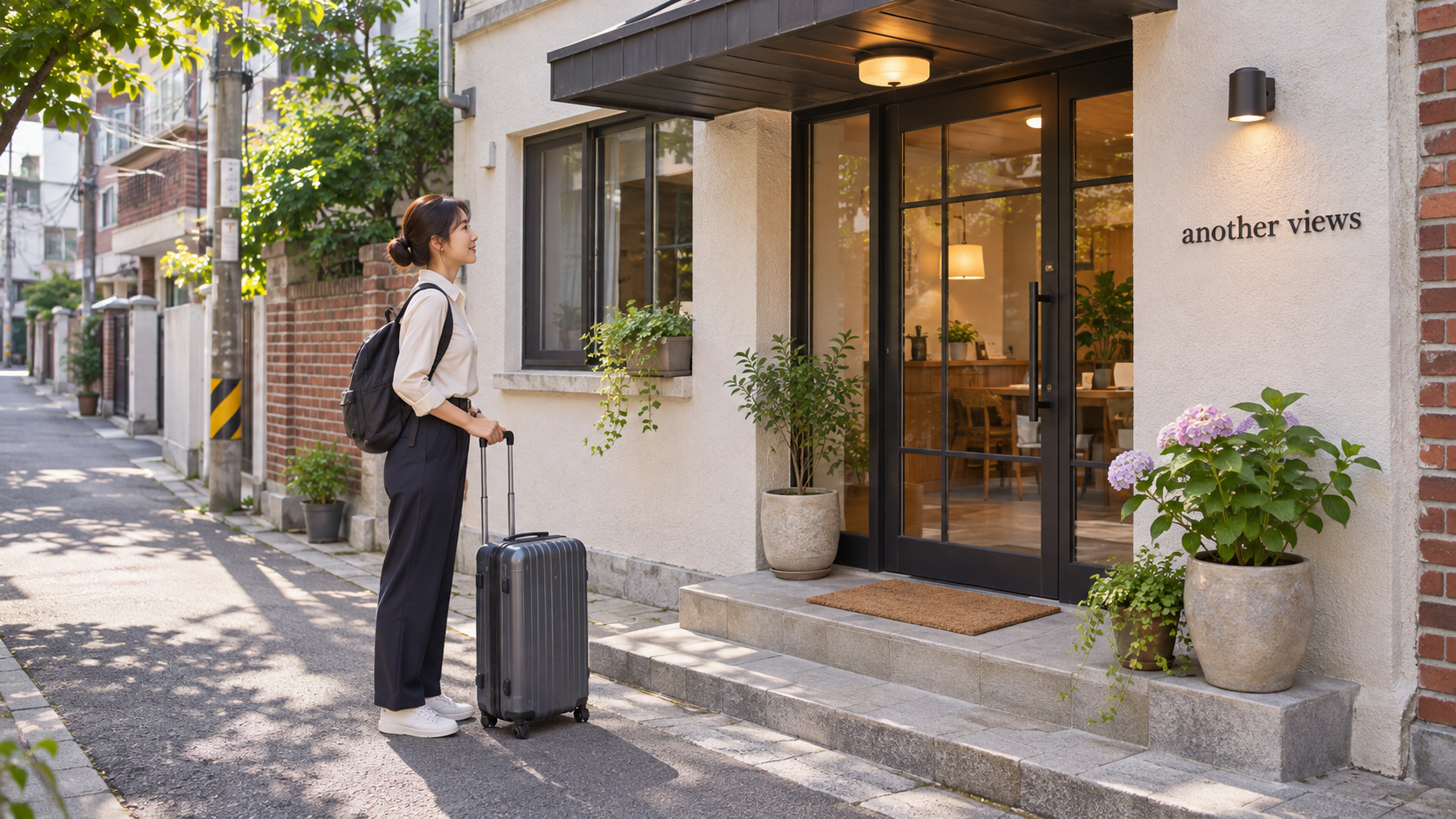
Imagine arriving in Korea and wheeling your suitcase toward the accommodation you booked. The room looked spacious in the photographs, and the price seemed reasonable. Only after leaving the station do you discover the stairs and the uphill walk. The palace you want to visit tomorrow and the venue for your evening performance are in different directions, too. This imagined arrival illustrates something room photographs cannot tell you: how a place will work as your travel base.
For a first trip to Korea, start by deciding which cities you will visit and how many nights to spend in each. Then choose a neighborhood within each city. Familiar names such as Myeongdong and Hongdae are useful starting points in Seoul, but the right location depends on your destinations, your evening plans, and how you will move with luggage.
This guide uses Seoul as its main example to explain how to choose a base. It does not rank individual hotels or compare live room prices. The same approach can help when you add other Korean cities to your itinerary.

Put three places you want to visit on a map first
You do not need a finished itinerary before booking accommodation. It helps, though, to identify three places you particularly want to visit. A trip built around palaces and museums may call for a different base from one centered on performances, shopping, or time in another city.
Mark those places on a map, then begin grouping them into days. Consider where each day will end as well as where it will begin. If a concert is the reason for your visit, check the journey back from the venue before choosing your accommodation. If you will travel between cities, include the station or terminal for your next departure.
Someone spending two days visiting palaces and one day exploring Gangnam has different needs from someone with several appointments or exhibitions south of the river. Look for a base that reduces the journeys you will repeat most often.
Which Seoul areas should you compare?
Visit Seoul, the city’s official tourism guide, groups attractions into areas including Gwanghwamun, Myeongdong, Hongdae, Itaewon, Gangnam, and Jamsil. These are useful tourism groupings, but booking platforms may use neighborhood names differently. Always check a property’s actual address and nearest station.
| Area to consider | When to compare it | What to check before booking |
|---|---|---|
| Myeongdong and Euljiro | When central-city sightseeing and shopping feature in your plans | Whether the property is closer to Myeongdong Station or Euljiro 1(il)-ga Station, and the walk from the relevant exit |
| Jongno, Insa-dong, and Anguk | When palaces and traditional cultural spaces are priorities | The nearest station, alley access, and stairs or elevators inside the property |
| Hongik University Station area | When music, shops, evening activities, and airport-rail access matter | Nearby businesses, room position, and the route through the station to your exit |
| Gangnam Station or Samseong Station area | When appointments, shopping, or exhibitions in the wider Gangnam area dominate your itinerary | The exact location: these are separate bases, so check the journey to your destination |
| Seoul Station area | When airport rail and trains departing from Seoul Station fit your plans | Your train’s actual departure station and which side of the station your accommodation is on |
These are starting points for comparison, rather than a ranking. The suggestions reflect the relationship between destinations, transport, and a traveler’s itinerary. A hotel on a main road and a small property in a nearby alley may offer quite different experiences within the same neighborhood.
Myeongdong is worth comparing if shopping is an important part of your visit. Pay attention to station names: Myeongdong Station is on Line 4, while Euljiro 1(il)-ga Station is on Line 2. They are separate stations, not one interchange. Check routes from the station that actually serves your accommodation.

Jongno, Insa-dong, and Anguk are candidates for an itinerary focused on traditional cultural spaces. Insa-dong has craft shops, galleries, and teahouses. A “Jongno” address alone does not establish that every palace is an easy walk away or that a room will be quiet at night. Look more closely at the street and station.
Hongdae is an area to consider for music, shopping, and evening activities. The AREX all-stop train serves Hongik University Station; the express train does not. Airport access and sleeping conditions are separate considerations, so check recent reviews and room location if noise matters to you.
Be specific about Gangnam. Accommodation described as being in Gangnam is not necessarily close to COEX. COEX provides access directions from Samseong Station and Bongeunsa Station. If you are considering a property near Gangnam Station, check the onward journey to the exact place you intend to visit.
Balance airport access with your everyday journeys
AREX express and all-stop trains serve different needs. The express runs between Incheon Airport and Seoul Station without intermediate stops. The all-stop service also serves stations such as Hongik University. Choose according to your destination, rather than assuming the express is always the more convenient option.

If you need to change trains at Seoul Station, include the transfer and final walk in your planning. When comparing an airport bus, check its actual stop and the route from there to the accommodation entrance.
For several nights in one place, weigh the two airport journeys against the trips you will make every day. If you arrive late and leave for another city the next morning, reducing the first night’s travel burden may deserve more weight. Your scheduled landing time also comes before immigration and baggage collection.
Check last departures, late-night services, and bus stops for your travel date. Fares and journey times depend on the service and starting terminal, so this guide does not present a single figure as a promise for every arrival.
Check the walk from the station exit to the front door
A short distance on a map does not necessarily mean an easy arrival. You may need to cross a wide road, use an exit with stairs, or walk around a building to reach its entrance. Even a short flight of steps can matter with a heavy suitcase.

Once you have two or three properties in mind, look up the walking route from the station exit to each entrance. Check elevator locations, crossings, and slopes, and read any arrival instructions supplied by the property. If you use a wheelchair or travel with a stroller, ask about access through the entrance and onward to the room and bathroom, as well as access at the station.
Treat an advertised walking time as a guide and allow for your own pace and luggage. Ask specific questions where details are unclear: “Can I reach the room with my suitcase without using stairs?” is more useful than a general question about convenience.
Compare the conditions for sleeping and leaving, too
Compare prices for the same dates, number of guests, and room conditions. Check the final total, including taxes and additional guest charges, alongside breakfast and cancellation terms. A neighborhood’s reputation for affordability cannot replace a comparison of the rooms actually available for your dates.

Check whether you are booking a bed or floor bedding, a private or shared bathroom, and a room reached by stairs or an elevator. The word “hanok,” meaning a traditional Korean house, does not establish the sleeping arrangements or bathroom facilities of every property. Separate the atmosphere you would enjoy from the facilities you need.
For a late arrival, confirm the check-in deadline and any self-check-in procedure. For an early arrival, ask whether luggage storage is available before the room is ready. Look through recent reviews for the issues that matter to you, such as noise, cleanliness, or heating and cooling, while remembering that an individual review may describe a particular room or stay. Confirm how you can contact the property and what language support is available.
If you are visiting other cities, divide the nights first
Before booking a Seoul room for your entire trip, consider what you want from any visit to Busan, Gyeongju, or another city. A day trip involves more than the train journey: add the time from your accommodation to the departure station and from the arrival station to your destination. If evening scenery or an early start matters, compare an overnight stay as well.

Check the departure and arrival stations for the train you intend to book. Staying near Seoul Station does not automatically simplify every intercity journey. Changing accommodation also takes time: checking out, moving luggage, and waiting to enter the next room all belong in the itinerary.
There is no fixed number of nights after which you must change bases. Staying in one place may suit travelers with substantial luggage or companions who find moving tiring. Staying elsewhere may make sense when you want time in another city’s evening or morning. Think about the experience you want there before counting how many cities you can include.
Follow a whole day before you book
Imagine beginning a day at each shortlisted property. Where will you board public transport in the morning, and how will you return after your evening plans? Apply the same check to your first and last days: where will your luggage go, and how will you reach the airport or your next departure station?

Compare the places you most want to visit, the journeys you will repeat, and the room conditions you need. A good base for a first Korea trip might be a popular hotel in a familiar neighborhood or a smaller property that fits your itinerary. The useful question is whether you can picture the day that begins and ends there, as clearly as you can picture the room.
Sources · Seoul Tourism Organization, Visit Seoul: Seoul Live Tourism Guide · Airport-to-city transport · Myeongdong · Euljiro 1(il)-ga access information · Insa-dong · Hongdae · COEX, Directions. Information checked November 15, 2026. Recheck transport services and property-specific conditions before booking.


답글 남기기