

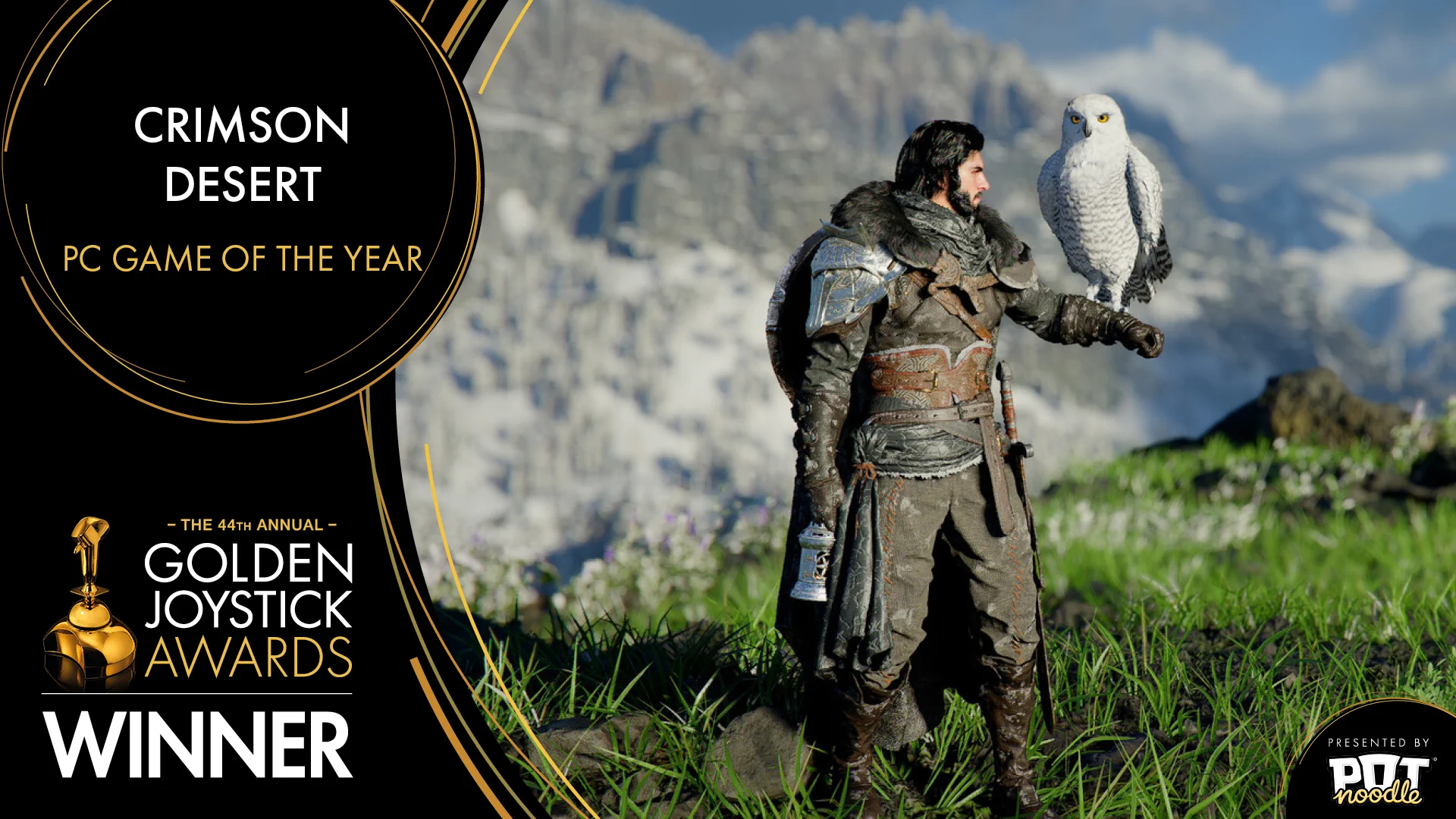
Crimson Desert has won PC Game of the Year at the Golden Joystick Awards 2026, becoming the first Korean-developed game to take the category since PlayerUnknown’s Battlegrounds in 2017.
The nine-year connection is worth examining. Where PUBG built its identity around multiplayer competition, Pearl Abyss’s winner offers a single-player open-world adventure. Two very different games have reached the same award category through different kinds of appeal.
But the trophy does not tell the whole story. International reviews have praised Crimson Desert’s scale while questioning its storytelling, controls, and clarity. Post-launch improvements have changed parts of the experience, and the developer has also faced questions about generative AI assets.
Its achievement becomes more interesting when those elements are considered together: what persuaded players to support it, what needed fixing, and what the award can—and cannot—establish.

What exactly did Crimson Desert win?
GamesRadar+’s official winners list names Crimson Desert as PC Game of the Year. The ceremony’s top prize, Ultimate Game of the Year, went to Resident Evil Requiem.
The distinction matters. Calling Crimson Desert the overall winner would misstate the result. Its award recognizes it within the PC category.
It is also more precise to describe the achievement as a nine-year return to this particular category than a long-awaited Korean return to the Golden Joysticks altogether. Lies of P: Overture won Best Game Expansion in 2025.
Public voting determines major Golden Joystick categories. The result demonstrates support among participating voters; it is not a representative survey of every PC player or a unanimous critical judgment.
Neither limitation diminishes the achievement. A new game world earned enough enthusiasm for people to choose it among competing nominees. The useful question is how that enthusiasm developed despite substantial criticism.
A project that changed direction
Crimson Desert did not begin with exactly the identity it has today. In its 2019 announcement, Pearl Abyss described an MMORPG combining single-player missions with multiplayer content. The company also explained that a concept originally connected to Black Desert had developed into a separate game with its own world and characters.

The released title is officially described as an open-world action-adventure. Built with Pearl Abyss’s proprietary BlackSpace Engine, it follows Kliff and the scattered Greymanes across the continent of Pywel.
| Stage | What changed | Why it matters |
|---|---|---|
| 2019 reveal | Presented as an MMORPG | The early proposal should be distinguished from the finished game |
| Release preparation | Delays moved the launch into 2026 | Expectations accumulated during a lengthy public development period |
| March 2026 launch | Released as a single-player open-world action-adventure | The playable experience became the basis for assessment |
| Post-launch updates | Changes to controls, loading, usability, and content | Launch reviews and later experiences require different context |
| November 2026 | Golden Joystick PC Game of the Year | A significant expression of voter support |
Delays are part of this history, but they do not reveal every internal development problem. When the planned 2025 release moved into 2026, Pearl Abyss cited longer-than-expected coordination around voice work, console certification, distribution partners, and other launch preparations, as reported by GameSpot.
Those were the company’s stated reasons. Rewriting them as proof of a single, undisclosed technical failure would go beyond the evidence.
International reviews found both attraction and friction
In her March 18 PC review, PC Gamer’s Mollie Taylor awarded Crimson Desert 80/100. Her assessment recognized the fascination of its enormous world and abundance of activities while criticizing its storytelling, unclear systems, and frustrating puzzles.
The central tension was not simply whether the game offered enough to do. Its density could be exhilarating for one player and exhausting for another.

Push Square provides a useful later perspective. In a May 22 reassessment, Robert Ramsey awarded the PS5 version 8/10 after returning to the game following extensive updates. He praised its world and exploration while retaining criticisms of its campaign, uneven quests, and remaining performance problems.
| Publication | Context | Score | Main tension |
|---|---|---|---|
| PC Gamer | PC review published March 18, 2026 | 80/100 | Compelling breadth versus unclear systems and uneven storytelling |
| Push Square | PS5 reassessment published May 22, 2026 | 8/10 | Improved playability and rewarding exploration versus persistent design weaknesses |
These scores cannot be arranged into a simple upward trend: the reviewers, platforms, and assessment dates differ. The comparison instead reveals a recurring question. Creating a world full of possibilities and helping players navigate those possibilities are separate design challenges.
Player support is visible, but its scope matters
On November 12, 2026, the Steam store page, then listed as Crimson Desert Enhanced, displayed “Very Positive” English-language reviews: 86% positive across 64,277 reviews.
That figure concerns English-language Steam reviews. It does not represent every language, platform, or purchaser, and review language does not establish a player’s nationality.
Together with the award, it provides evidence of substantial support among particular participating groups. It does not prove that overseas audiences universally agree.

One interpretation is that many players found enough value in exploration and experimentation to outweigh the friction they encountered. Acknowledging that value does not require dismissing the criticisms. Players can recognize the same weakness and assign it different importance within the overall experience.
There were real problems—and documented responses
The generative AI controversy deserves a clear account. In a March statement reproduced by Push Square, Pearl Abyss acknowledged that some experimental AI-generated 2D visual props from early development had unintentionally remained in the final release.
The company apologized and acknowledged that it should have disclosed its AI use more clearly. This was therefore more than an unconfirmed allegation. Equally, the statement did not establish that the entire game had been generated with AI.
The official version 1.01.00 patch notes, dated March 28 in UTC, subsequently recorded the replacement of selected 2D visual assets. They also documented shorter loading times for fast travel and revival, alongside further control changes.

Those records establish that changes were made. They do not independently demonstrate that every affected asset or every player concern was resolved.
Updates should be assessed without erasing launch conditions. A better experience months later can deserve recognition, while players who encountered the earlier problems still have legitimate grounds for criticism. The award makes responsiveness worth examining; it does not remove responsibility for quality and transparency.
Sales success is a separate part of the picture
In a June 11 announcement distributed by its PR agency, Pearl Abyss said Crimson Desert had surpassed six million copies sold worldwide. The same release reported two million copies on launch day and five million within its first month.
These are company-reported milestones, and six million is a June figure—not a verified November total.
Multiplying copies by the standard retail price would not establish revenue or profit. Regional pricing, discounts, refunds, platform fees, and development and marketing costs complicate that calculation.

The more defensible conclusion is that sales, review sentiment, and awards offer different evidence. Commercial reach, satisfaction among review writers, and willingness to vote for a game are related, but they are not interchangeable.
Three Korean-connected projects to watch next
For readers discovering Korean games through Crimson Desert, several developing projects offer different directions. Their announced ambitions should be distinguished from assessments of finished games.
| Project | Announced direction | What to watch |
|---|---|---|
| DokeV | Pearl Abyss’s creature-collecting open-world action-adventure | How collecting and exploration connect in sustained play |
| Chrono Odyssey | Chrono Studio’s action MMORPG, published by Kakao Games, featuring time manipulation | Combat, online play, and performance following beta feedback |
| Project Windless | A single-player open-world action RPG set in the universe of Lee Yeong-do’s The Bird That Drinks Tears | How the literary world becomes meaningful action and choice |
Chrono Odyssey’s developers have acknowledged frame-rate and crash concerns from its closed beta in their official development updates. Project Windless, meanwhile, is led by KRAFTON Montréal Studio in collaboration with teams in Korea. Korean corporate ownership, source material, and development location are distinct parts of these projects’ identities.
The variety is itself worth noticing. Korean-connected game development includes different genres and international working arrangements, rather than a single formula waiting to be repeated.
What remains after the ceremony
The link back to PUBG gives Crimson Desert’s win historical context. Nine years after a multiplayer phenomenon took PC Game of the Year, a Korean-developed single-player adventure has won the same category.

Its story is also a reminder that strong support does not require unanimous praise. The breadth that held some players’ attention also created barriers for others. Updates changed the experience, while questions about its original design and production practices remained relevant.
The trophy is a reason to examine that journey. For the next wave of games, the most revealing questions will concern the experience behind the spectacle: how convincingly a world plays, how clearly it communicates, and how responsibly its developers respond when problems emerge.
Sources and further reading
- GamesRadar+: Golden Joystick Awards 2026 winners; PC Gamer: 2017 winners.
- Pearl Abyss: 2019 project announcement — Korean-language development history.
- PC Gamer: Crimson Desert review; Push Square: May 2026 reassessment.
- Steam: English-language review summary — figures checked November 12, 2026; totals change over time.
- Push Square: Pearl Abyss’s AI statement; official version 1.01.00 patch notes.
- Pearl Abyss announcement: Six million copies sold — June 11, 2026.
- Chrono Odyssey: Official development announcements — including the optimization update discussed above.
This article synthesizes published reviews, official announcements, and publicly available player-review data. It is not a firsthand gameplay review.


답글 남기기