
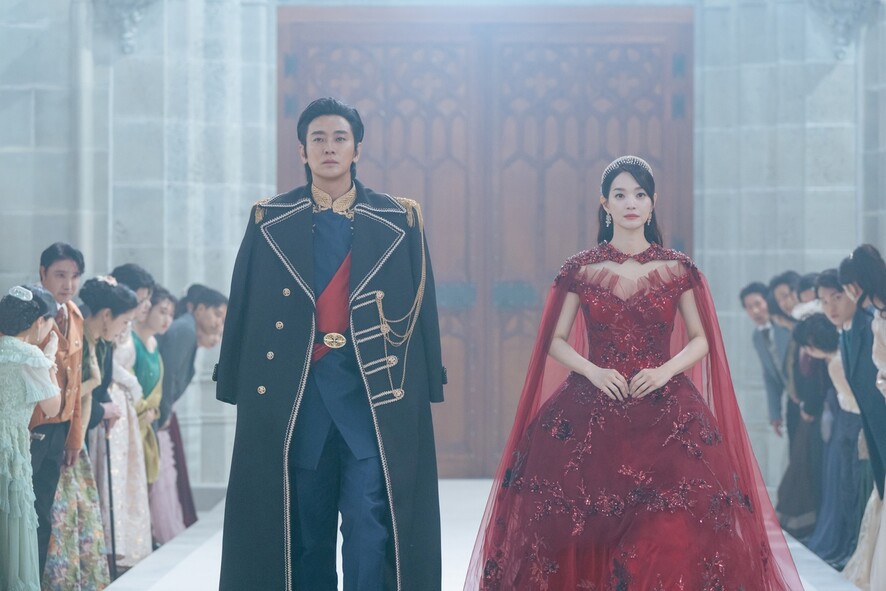
Korean actors wear elaborate gowns, move through European-inspired palaces, and address one another as Navier and Sovieshu. Before the central romance of The Remarried Empress unfolds, its appearance poses a question of its own: can this unfamiliar combination become a convincing fantasy world?
Some viewers notice the distance between the performers and their costumes. Others find that very unfamiliarity inviting. Early reviews suggest that how audiences enter this world is an important part of how they judge it.
But the responses do not support a simple story of Korean rejection and international acclaim. Favorable English-language reviews contain reservations about pacing, while a more cautious Korean review recognizes the adaptation’s visual achievements. The revealing differences lie in what each writer finds persuasive—and where immersion begins to weaken.
Spoiler note: This article discusses the premise and relationships established in Episodes 1–4. It does not reveal the original story’s ending. The reviews discussed cover the opening three or four episodes, rather than the completed series. Sources were checked through November 6, 2026.

A European-inspired setting with Korean storytelling roots
It is easy to understand the first impression that The Remarried Empress looks unlike a conventional Korean historical drama. Gowns replace hanbok, the palace belongs to an imaginary empire, and the characters have names unrelated to Korean history.
Yet the story has its own place within Korean popular culture. The series adapts a Korean web novel and webtoon, bringing a fantasy world developed within those storytelling traditions to live action.
According to reporting published by The Korea Times, Studio N CEO Kwon Mi-kyung explained that moving the story to a specific period in Korean history would have diminished the original’s appeal. The production retained its imagined world rather than turning it into a more familiar historical setting.
That choice also creates a particular adaptation challenge. Costumes and names that feel natural in illustrated panels take on a different presence when attached to an actor’s body and voice. Reproducing the source material’s appearance and making the resulting screen world convincing are related tasks, but they are not identical.
What favorable international reviews find compelling
Writing for But Why Tho?, Mike BC awarded Episodes 1–4 an 8.5 out of 10. His review praises Shin Mina’s performance as Navier, the contrasting relationships, and the atmosphere created by the music and production design.
In that reading, Navier offers more than the image of a betrayed wife. She remains a leader carrying out her responsibilities while the emperor becomes absorbed in another relationship. Her behavior gives viewers a reason to invest in her beyond the promise of romantic revenge.

The high score comes with a reservation: the lengthy setup. Mike BC points out that four episodes into a ten-episode series, the divorce and remarriage promised by the title have yet to arrive. Enjoying the world and its relationships does not eliminate the wait for its central development.
RIOTUS critic Sherin Nicole approaches the opening three episodes through the pleasures of romantasy—the combination of romance and fantasy. Her review connects the series with interests associated with Bridgerton and Fourth Wing: opulence, dangerous relationships, magic, and competing ambitions.
Within that framework, Korean actors inhabiting a European-inspired fantasy are not automatically a problem to overcome. The question becomes whether the world is enticing and whether its relationships make the next scene irresistible.
A cautious Korean review still recognizes the experiment’s strengths
Cineplay’s Seong Chan-eol gave the opening four episodes three stars. He found the live-action realization more assured than he had feared, recognizing the appeal of the costumes and sets.
His reservations concern what supports that appearance: unexplained details, characters behaving conventionally, and a story that has not yet developed a sufficiently strong pull. He also questions how well the menswear and womenswear designs work together.
This is a more qualified response than the favorable English-language reviews discussed above. But it does not dismiss the entire premise of Korean actors performing in a Western-style fantasy world. It recognizes the experiment’s possibilities while asking more of its dramatic momentum and visual consistency.

Reading the reviews closely also reveals common ground. Both But Why Tho? and Cineplay acknowledge the attraction of the production while expressing some dissatisfaction with the opening stretch’s progression. Their overall enthusiasm differs; their concerns are not entirely opposed.
For fans, unfamiliarity can be an invitation
Personal viewing accounts offer another perspective, although they cannot establish the balance of opinion among international audiences.
In a Busan International Film Festival viewing diary, Ruth, who runs A Fangirl’s Heart, describes watching the first three episodes without having read the original web novel or webtoon. She welcomes the combination of Korean actors, Western-style names, and fictional kingdoms as something fresh. The colors and atmosphere reminded her of Wicked.
Her account shows that the series’ appearance can create a sense of discovery. It remains one fan’s experience, however, rather than evidence of what international fans collectively believe. The language of a post alone also does not establish its author’s nationality.
Korean-language discussion is similarly varied. In one Fanplus community thread, comments welcome the preservation of the original romantic-fantasy world, while another expresses a preference for a Korean historical-drama approach. Some comments describe viewing; others express expectations before watching. They should not be combined into a single verdict.
Link note: The Fanplus thread contains major spoilers for the original story.
These examples reveal different expectations more clearly than they reveal national divisions. A reader hoping to see the source material preserved may approach the series differently from someone primarily concerned with natural-looking costumes or immediately convincing relationships.

Beneath the unfamiliar palace is a recognizable relationship drama
In her first-impressions review for DramaPanda, Anne J describes initially wondering whether the project might become painfully cheesy. After the opening episodes, she found it surprisingly addictive, emphasizing infidelity, a collapsing marriage, and the anticipation of Navier’s response.
The palace and magic may be unfamiliar, but betrayal and unequal relationships are readily recognizable. One way to understand the adaptation’s challenge is to ask how effectively it connects those two layers.
When the spectacle intensifies the characters’ emotions, the fantasy can become an attraction. When a costume or stylistic choice draws attention away from the people wearing it, that same spectacle can create distance. This is an interpretation of the questions raised by the early responses, rather than a claim about every viewer’s experience.
The divide is more complicated than Korea versus overseas
The reviews examined here are too few—and too early—to establish a Korean or international consensus. They also mix different viewing circumstances: advance screenings, the opening four episodes, professional reviews, and personal fan accounts.
What they do show is a shared negotiation between visual attraction and dramatic conviction. Favorable reviews praise the performances and fantasy atmosphere. A more cautious Korean review recognizes those attractions while asking for stronger narrative rewards. Even a highly positive review questions the length of the setup.

The Remarried Empress therefore raises a more interesting question than whether Korean and international viewers disagree. When a Korean drama moves beyond its familiar visual settings, what makes that change feel awkward to one viewer and exciting to another?
Its early reception suggests that the boundary depends on what each viewer brings to the screen—and how quickly the people inside the palace become more compelling than the palace itself.
Sources
- The Walt Disney Company: premiere announcement, November 3, 2026.
- But Why Tho?: Mike BC’s review of Episodes 1–4.
- RIOTUS: Sherin Nicole’s review of the first three episodes.
- Cineplay: Seong Chan-eol’s opening-episode assessment, November 5, 2026.
- The Korea Times: reporting on the adaptation’s setting and production choices.
- A Fangirl’s Heart: a personal BIFF viewing account.
- DramaPanda: Anne J’s first impressions.
- Fanplus: a Korean-language discussion thread containing original-story spoilers.



답글 남기기