
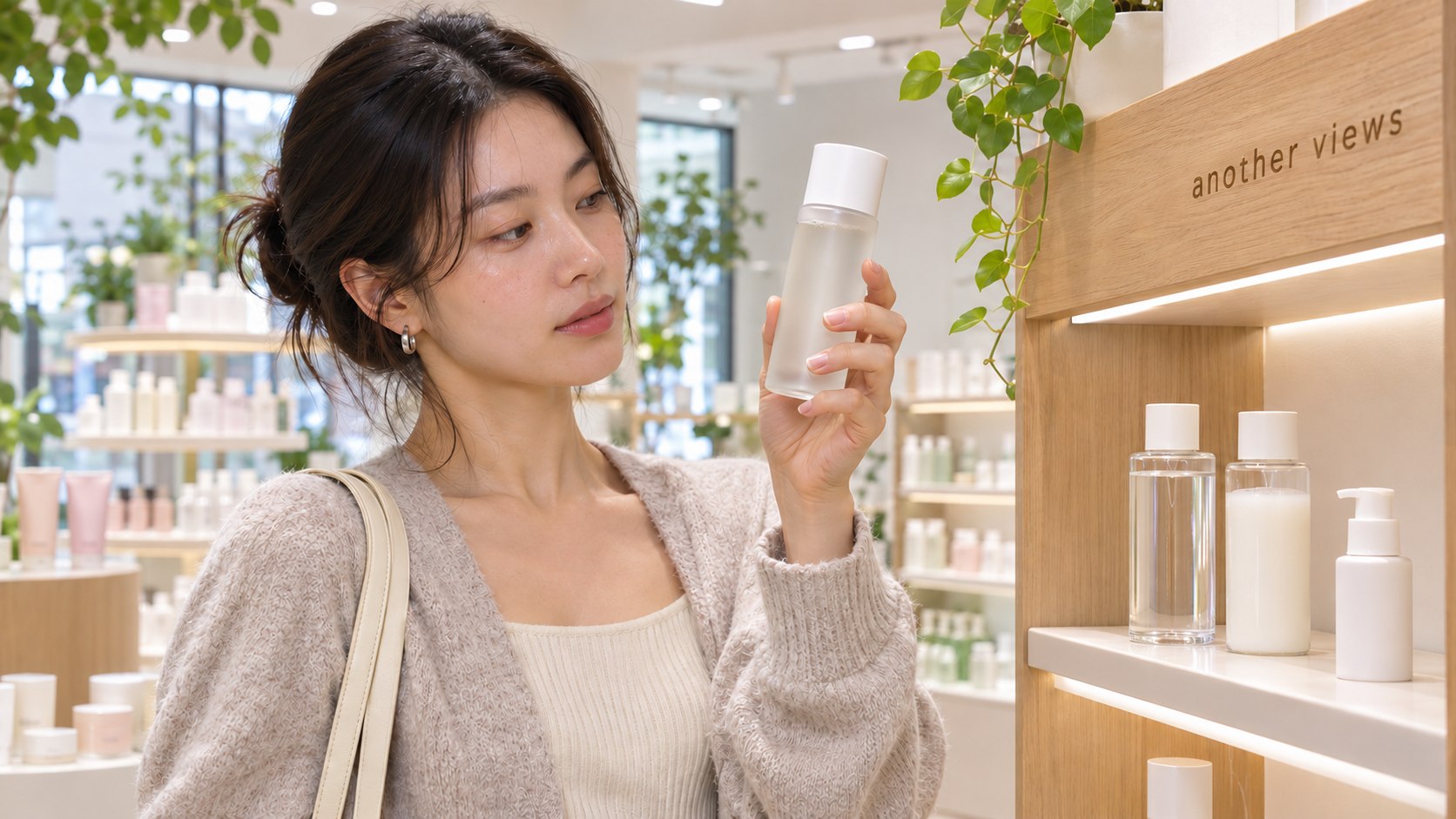
You walk into a Korean beauty store looking for one hydrating product. A bottle of milky toner catches your eye. Next to it are a hydrating serum, an essence, and an ampoule. You already own a serum. Would an essence add anything? And is the ampoule supposed to be stronger?
Start with what you want the new product to do. If your serum and moisturizer already give you the feel and hydration you want, you can skip the extra purchase. If you want a lighter layer after washing your face or a different texture under your moisturizer, compare how the products feel and how the brand tells you to use them.
Why do two toners look so different?
Put Round Lab’s 1025 Dokdo Toner next to Laneige’s Cream Skin and the word toner suddenly tells you less than you might expect. Round Lab describes a watery formula and directs shoppers to apply it after cleansing with a cotton pad. Laneige calls Cream Skin a Toner & Moisturizer on its international site and describes a milky formula. The two labels give you a reason to compare the feel and purpose of each product.

“Milky” describes the formula’s appearance and texture. Whether that product can take the place of your usual cream depends on how it fits your routine. The word “toner” can also appear on a tub of pre-soaked pads. On its Dokdo Toner Pad, Round Lab gives different directions for the textured and smooth sides. If you are choosing between a bottle and a tub of pads, think about how you would use each on an ordinary morning.
Do essence, serum, and ampoule each get a step?
COSRX directs shoppers to apply its Advanced Snail 96 Mucin Power Essence after cleansing and toning, then follow with moisturizer. Torriden’s Korean listing for its 75 mL DIVE IN serum tells shoppers to spread the product evenly over the skin and pat it in. SKIN1004 presents its Madagascar Centella Ampoule as a watery product to apply after cleansing and leave on. In these examples, three different names can point to a similar place in the routine.

The word ampoule also appears on SKIN1004’s Centella Ampoule Foam, which the brand instructs shoppers to rinse off. Read the full name and check the directions. If an ampoule and a serum both list a percentage, check which ingredient each number refers to. The percentage of snail secretion filtrate disclosed by COSRX describes that ingredient’s share of one formula. A percentage for a different ingredient in a different formula gives you no common basis for comparing hydration.
| Label on the shelf | What to check |
|---|---|
| Toner | Look for a watery or milky texture and directions for applying it by hand or with a pad. |
| Essence | Read what it is intended to do and whether the directions call for a moisturizer afterward. |
| Serum | Compare its stated purpose with the products you already use. |
| Ampoule | Check the full product name, the formula details, and whether it stays on or rinses off. |
Do I need a toner if I already use a serum?
Say you cleanse at night, use a hydrating serum, then put on a cream you like. If that routine feels comfortable, a hydrating toner may fill a role you already cover. If you are curious about the feel of a lighter product, keep the toner in mind for when your serum runs out. You can compare the two without adding another bottle to your shelf today.

Now imagine you often skip your cream because it feels heavy. Look at the step you keep skipping. A moisturizer you like using may be a better place to start your search than another layer to put underneath it. The American Academy of Dermatology describes cleansing, moisturizing, and sun protection as a simple foundation. It also advises trying a new product on a small area before applying it more widely.
When you are down to two bottles, turn them around. Compare what each is for, how you would use it, and what would change in the routine you already have. If both cover a step you are happy with, you can leave both on the shelf.
Further Reading
- Korean Skincare: Do You Really Need All Ten Steps?
- Why Tourists Visit Olive Young—and the K-Beauty Industry Behind Its Shelves
Sources
- Round Lab, 1025 Dokdo Toner and 1025 Dokdo Toner Pad.
- Laneige International, Cream Skin Cerapeptide Toner & Moisturizer.
- COSRX, Advanced Snail 96 Mucin Power Essence.
- Torriden Korea, DIVE IN Low Molecular Hyaluronic Acid Serum, 75 mL.
- SKIN1004, Find Your Centella Routine.
- American Academy of Dermatology, Skin Care on a Budget and How to Test Skin Care Products.



답글 남기기