
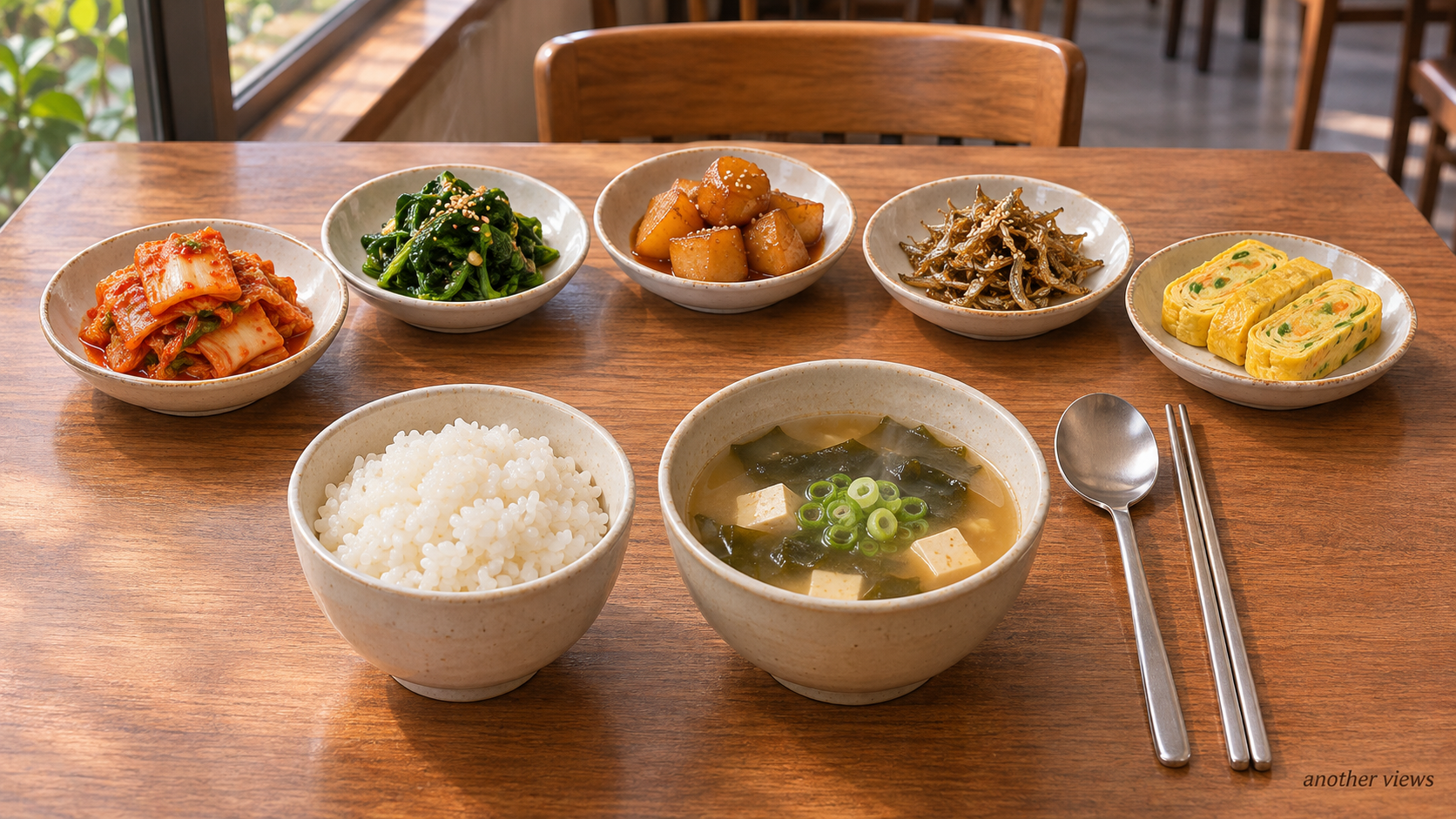
You order a bowl of stew at a Korean restaurant. Before it arrives, small plates begin appearing: cabbage kimchi, seasoned vegetables, perhaps braised potatoes or stir-fried anchovies. If this is your first visit, you may hesitate. Did you order these? Should you finish them before the stew? Will each plate appear on the bill?
These foods are called banchan (반찬), usually translated as “Korean side dishes.” To understand them, look at the bowl of rice that accompanies the meal. Banchan give you different flavors to enjoy with it, one bite at a time.
One Bowl of Rice, Several Ways to Eat It
Rice, soup, and banchan form a familiar everyday Korean meal. In this arrangement, the meal does not depend on a single large centerpiece. Rice and its accompaniments work together.

Imagine rice with cabbage kimchi, seasoned spinach, and braised potatoes. One mouthful might pair rice with tangy kimchi; the next brings the softer texture of spinach or potatoes. Separate dishes keep those foods distinct while letting you choose your own combinations.
This is one important Korean meal format, rather than a rule for everything eaten in Korea. A bowl of noodles or a roll of gimbap can also be a meal. What appears beside your order depends on the restaurant and the food you choose.
They Stay With You Through the Meal
Banchan may arrive first, but they are generally meant to accompany the meal rather than disappear before it begins. You can taste a little while waiting, then continue eating them with your rice and other dishes.
There is no required sequence. Try some rice, taste a side dish, and move between the foods you enjoy. You do not need to empty one plate before starting another.
Nor do you need to mix every side dish into your rice. Bibimbap is designed for mixing; a bowl of plain rice surrounded by banchan gives you other possibilities. Start by tasting the foods separately, then see which combinations you like.

What Might Be in Those Small Dishes?
Banchan describes a food’s role in a meal, not one ingredient or cooking method. The selection can include fermented foods, seasoned vegetables, pickles, stir-fries, braised foods, meat, and fish. The dishes below are examples, not a standard set that every restaurant serves.
| Banchan | What it is | What to notice |
|---|---|---|
| Baechu kimchi (배추김치) | Salted, seasoned, fermented napa cabbage | Tanginess and texture change as it ferments. |
| Namul (나물) | Vegetable dishes prepared in various ways, including seasoning and stir-frying | The vegetable and preparation shape the flavor and texture. |
| Jangajji (장아찌) | Pickled foods, often vegetables preserved in soy-based or other pickling mixtures | Saltiness, sweetness, and acidity vary. |
| Myeolchi bokkeum (멸치볶음) | Seasoned, stir-fried dried anchovies | Anchovy size and seasoning affect the texture; some versions include nuts. |
| Jangjorim (장조림) | Meat, eggs, or other ingredients simmered in soy-based seasoning | Check which ingredients the restaurant uses. |
A red plate of kimchi does not mean everything will be spicy. Equally, a vegetable dish is not automatically vegetarian: kimchi may contain fish sauce or salted seafood. If you have dietary restrictions or allergies, name the specific ingredients you avoid and ask about seasonings as well as visible ingredients.
Why the Selection Changes From Restaurant to Restaurant
Some meals come with just kimchi and cubed radish kimchi. Others include several vegetable dishes and grilled fish. A smaller selection does not automatically make a meal less Korean.

If you want to explore rice with a variety of accompaniments, look for baekban (백반), an everyday meal built around rice, soup, and banchan. The name does not promise an identical selection or number of plates everywhere.
Korea’s regional ingredients and varied cooking methods help explain the range of foods found on its tables. For a diner, the useful question is how the dishes fit the meal, rather than how many plates make a setting “authentic.”
Are Banchan Free, and Can You Ask for More?
Basic banchan served with a meal are generally included in its price. In Korea, many restaurants also replenish basic side dishes without an extra charge. Some have a self-service station.
Check the restaurant’s notices or ask staff before assuming that every dish is unlimited. A separately priced menu item is different from an included accompaniment. Korean restaurants outside Korea may follow different policies.

Point to the dish you would like and ask “이 반찬 조금 더 주실 수 있나요?”—“Could we have a little more of this side dish?” To check the cost, ask “추가 비용이 있나요?”—“Is there an extra charge?”
At a self-service station, use the serving utensils provided. Take a small amount first and return if you would like more.
Shared Dishes, Your Own Meal
When several people dine together, rice and soup may be served individually while banchan sit in the center to share. Other restaurants provide individual trays or separate settings. Follow the arrangement in front of you.

Use serving utensils where provided, and take a small portion onto your own side plate. You can ask for an extra plate or serving utensil if needed.
Back at that first table, the stew has arrived beside your rice. Try some kimchi, then a little spinach, then a bite of potato with rice. You do not need to memorize every name before enjoying the meal. The purpose of those small plates becomes clearer as you eat: each offers another way to enjoy the same bowl of rice.
Sources
Korean Food Promotion Institute, “The Roots of Hansik, Home-Cooked Meals”, 2024.
Korea Tourism Organization, “About Korean Food,” VISITKOREA.
National Institute of Korean Language, Practical Korean Expressions for Foreigners, restaurant section.
Maangchi, “Korean Side Dish Recipes”.



답글 남기기