
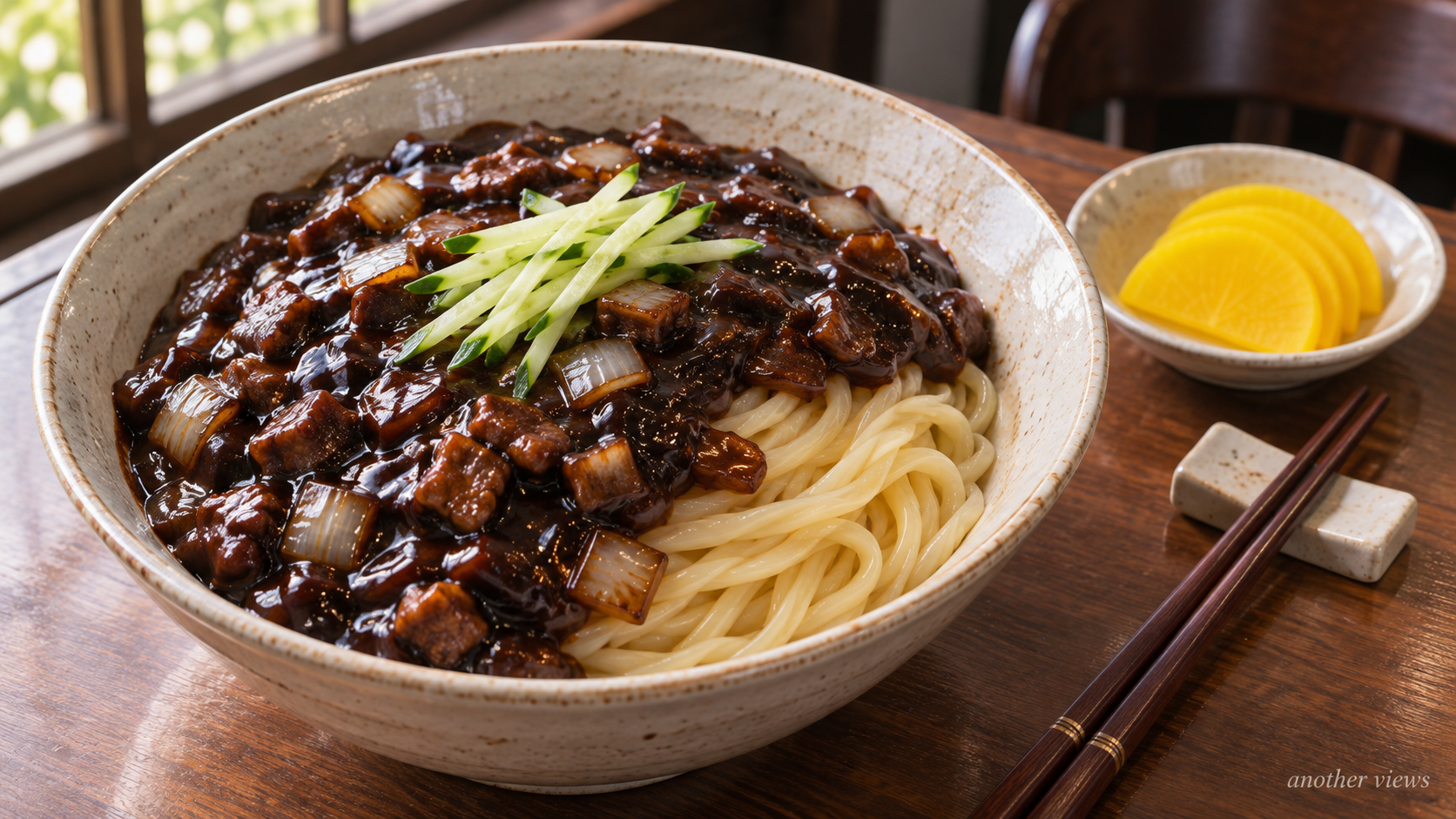
A bowl of noodles arrives under a glossy dark sauce. Someone mixes everything together, coating the strands before taking the first bite. For an international viewer watching a Korean drama, jajangmyeon may begin as a question: what is that dish?
For someone who grew up eating it, the same bowl might recall a family outing or a delivery meal at home. One person encounters a new flavor; another recognizes an old memory.
Jajangmyeon’s place in Korea becomes clearer when we look beyond its ingredients. Its history connects Chinese migration, changing restaurant habits, and the convenience of having a meal brought to the door.
The story begins with migration
Jajangmyeon’s roots are closely associated with the Chinese community that developed around Incheon after the port opened in 1883. The Korea Tourism Organization traces its arrival to Chinese zhajiangmian and its subsequent adaptation in Korea.

Chinese residents and restaurant operators were central to that process. Describing the dish only as a foreign recipe adjusted to Korean tastes leaves out the people who cooked it, sold it, and built livelihoods around it.
Anthropologist Young-Kyun Yang’s 2005 study examines how Chinese food and restaurants changed their position in Korean society. Its published abstract describes a transition from establishments serving Chinese residents to restaurants that became important places for Koreans to eat out during the 1950s and 1960s. By the 1970s, Korean customers formed the overwhelming majority of their clientele.
This helps explain an apparent contradiction. Koreans can still call a restaurant a junggukjip, or Chinese restaurant, while remembering its food as part of their own childhood. Awareness of a dish’s origins can coexist with a deeply personal sense of belonging.
How the bowl changed in Korea
Jajangmyeon generally combines wheat noodles with a sauce based on chunjang, often cooked with pork and vegetables such as onions. Recipes vary by restaurant and style.
The familiar dark sauce developed over time. The Korea Tourism Organization describes earlier versions as browner and identifies changes in sauce production, postwar flour supplies, and expanding pork and onion production among the factors behind the dish’s development and wider availability.
The English description “black bean noodles” can therefore be misleading if taken literally. It does not mean that whole black beans are necessarily responsible for the sauce’s appearance.

China’s zhajiangmian also has regional variations. Reducing the comparison to “Chinese noodles are salty; Korean noodles are sweet” would flatten that diversity.
A more revealing question is how a dish changes when it becomes part of a new food economy. Available ingredients, restaurant practices, and customers’ preferences all help shape what eventually feels familiar.
From a special outing to an ordinary meal
In his 2009 study of jajangmyeon’s cultural meanings, Kim Mantae identifies several factors in its establishment in Korea: the growth of Chinese restaurants, changes in preparation, accessible prices, and the spread of dining out and delivery. The published abstract also discusses nostalgia and the dish’s movement from a special food toward an everyday meal.
That combination matters. Flavor alone cannot explain why a dish becomes widely eaten. People need places to find it, opportunities to afford it, and reasons to choose it repeatedly.
The same food can consequently carry different meanings at different stages of life. A meal once associated with going out with family can later become a convenient lunch ordered at work.
This does not give every Korean the same memory. Generation, household circumstances, location, and preference all affect the relationship. “Comfort food” describes overlapping experiences, not a national rule about what everyone must enjoy.
Graduation meals and the delivery box
Two recurring images help explain jajangmyeon’s cultural associations: a family eating out after a graduation ceremony, and the metal delivery carrier known as a cheolgabang.
The National Museum of Korean Contemporary History’s archive documents displays at Incheon’s Jajangmyeon Museum that recreate a graduation-day restaurant meal and show different types of delivery carriers.

These images capture two ways a meal acquires meaning. The family outing connects food with an occasion worth remembering. The delivery carrier connects it with the practical task of feeding people wherever they are.
Delivery also changes our understanding of a restaurant’s reach. Its food can become familiar to people who rarely sit at its tables. Ordering, waiting, receiving the meal, and eating together become part of the experience.
This offers another way to read a jajangmyeon scene in a drama. Notice who is sharing the meal and where they are eating. The setting and relationships can tell you as much as the menu.
A short guide to the menu
For a first-time diner, several similar names can be confusing. These are general distinctions; preparation and presentation vary between restaurants.
| Menu name | General characteristic | What to notice |
|---|---|---|
| Jajangmyeon | Noodles topped with a chunjang-based sauce | The sauce’s consistency and how it coats the noodles |
| Ganjjajang | Typically stir-fried to order, with sauce often served separately | The texture of the onions and other ingredients |
| Yuni-jajang | Made with finely minced meat and vegetables | The finer texture of the sauce |
Starting with a standard bowl and comparing other versions later can be more useful than searching immediately for a single “authentic” version. A familiar-looking menu contains room for different textures and preferences.
Incheon offers a way to explore the history
Visitors interested in the background can connect a meal in Incheon’s Chinatown with the Jajangmyeon Museum, housed in the former Gonghwachun restaurant building.
The broader history is best understood through the Chinese community, multiple restaurants, and changes in food production and consumption. Identifying one restaurant and one year as the complete moment of invention would make that process seem simpler than it was.

Jajangmyeon allows us to acknowledge Chinese origins while exploring the experiences formed around the dish in Korea. Both belong in the story.
For a newcomer, the sauce may offer an unfamiliar taste. Knowing something of the migration, family outings, and delivery meals behind it adds another layer. The next time a drama character mixes those dark noodles, the scene may feel a little more familiar too.
Sources and further reading
- Korea Tourism Organization: “Jjajangmyeon: A Korean-Chinese Favorite for All Ages” — an introduction to the dish, its development, and common varieties.
- Young-Kyun Yang, “Jajangmyeon and Junggukjip: The Changing Position and Meaning of Chinese Food and Chinese Restaurants in Korean Society”, Korea Journal, 45(2), 2005, pp. 60–88 — this article draws on the publicly available abstract.
- Kim Mantae, “Inculturation Factors and Cultural Meanings of ‘Jjajangmyeon’”, The Korean Folklore, 50, 2009, pp. 159–207 — this article summarizes points in the publicly available abstract.
- National Museum of Korean Contemporary History: Incheon Chinatown archive — photographs and descriptions documenting museum displays; Korean-language resource.


답글 남기기