
Spoiler notice: This article discusses major early-story developments and selected events through Episode 6 of 100 Days of Deception.
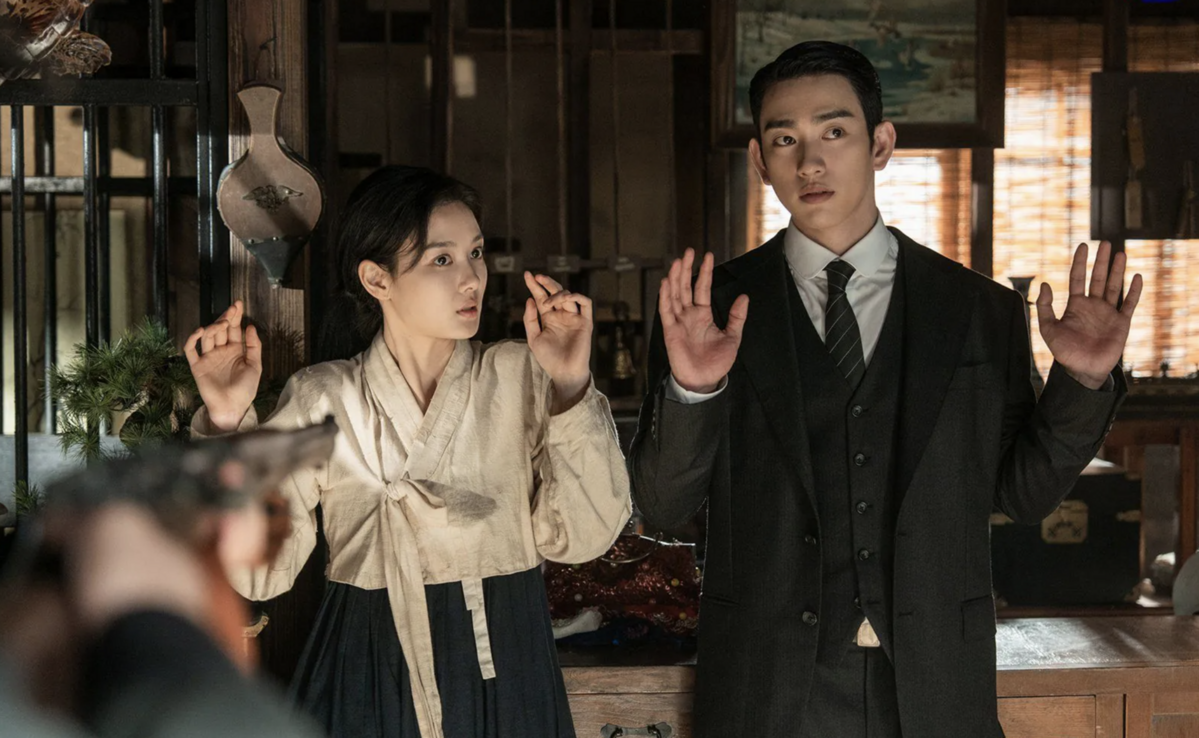
The heroine of a drama about Korea’s independence movement wants to leave Korea. Lee Ga-gyeong, the pickpocket at the center of 100 Days of Deception, dreams of reaching America and starting over. Money and safety matter more immediately to her than patriotic sacrifice. Yet she becomes an undercover operative inside the Japanese colonial administration.
That contradiction gives international viewers a way into the story without requiring extensive knowledge of Korean history. Why would someone who wants to escape accept such a dangerous mission? When might the lies she tells to protect herself begin to protect someone else?
Korean and international reviews offer complementary ways to approach those questions. The suspense and romantic tension draw attention, while criticism focused on survival, language, and identity helps explain what gives the characters their emotional weight. The reviews discussed here address the opening episodes or particular installments, rather than the completed series.

A heroine who does not begin as a patriot
Understanding Ga-gyeong does not require assuming that patriotism secretly drives everything she does. Her desire to leave a place that has offered her little protection is an important starting point in its own right.
In its review of the drama, DaebakDaily emphasizes her practical desire to survive and escape. Becoming involved in a resistance operation does not instantly replace her private ambitions with a fully formed political commitment.
Writing for IZE in a review carried by MoneyToday, Han Su-jin approaches that development through Ga-gyeong’s response to another person’s suffering. Small acts of concern begin to connect a life organized around self-preservation with the larger realities of the period.
Read together, these perspectives suggest why the character is a useful entry point. She does not arrive with a completed moral lesson to deliver. Her wish to stay alive exists alongside a growing difficulty in ignoring what happens to other people. Following her choices makes the personal cost of resistance easier to grasp.

The performance matters to that progression. In Ilgan Sports, reporter Kim Ji-hye highlights Kim You-jung’s balance between the character’s playful resourcefulness and the weight of her circumstances. Ga-gyeong needs that liveliness: when maintaining it becomes difficult, the change carries emotional force.
Three languages—and unequal access to information
Ga-gyeong’s movement between Korean, Japanese, and English naturally draws attention to the actors’ language work. But pronunciation and fluency explain only part of what those exchanges do.
In his iMBC review, Baek Seung-hun identifies multilingual interpretation as a source of psychological tension. People can occupy the same room without having equal access to the conversation. Who understands, who misunderstands, and who conceals their understanding can alter the danger of a scene.

Lee Ja-yeon’s Channel YES column on language and liberation develops a related but distinct argument. She reads Ga-gyeong’s English and her ability to lie as ways of gaining limited agency within conditions that sharply restrict her choices.
That perspective is especially useful when watching with English subtitles. Subtitles can make the meaning of several languages equally accessible to the viewer. Within the scene, however, the characters may understand very different things. Watching when someone switches languages can therefore reveal who briefly gains control over an exchange.
This does not mean that every lie becomes morally defensible. It asks a more specific question: how freely can someone tell the truth when they lack the power to survive its consequences? Language becomes part of the struggle over who can know, speak, and act.
False names and feelings that cannot stay hidden
An assumed identity creates the possibility of exposure. It also raises a quieter question: what does living under that identity do to the person using it?
In his Entermedia column, cultural critic Jung Duk-hyun reads Ga-gyeong and Tae-woong as young people unable to live openly as themselves. He connects their false identities and efforts to appear emotionally untroubled with personal abandonment and the conditions of colonial rule.

Through that lens, their relationship involves more than discovering each other’s secrets. It also involves whether either person can admit vulnerability. In a world where suspicion offers protection, allowing someone to see genuine distress carries its own risk.
A Dispatch review by Yoo Ha-neul offers a useful performance detail here: Park Jin-young conveys anxiety and anger beneath a controlled exterior. Such restraint has to communicate an active conflict. Otherwise, a guarded character can become emotionally unreadable.
This is where an abstract subject such as identity becomes tangible. A hesitation, a defensive glance, or a brief change in expression can make the pressure of maintaining a role visible.
The romance needs a convincing sense of danger
Decider’s opening review recommends the series and responds positively to its combination of intrigue, romance, and history. Those elements still need to support one another as the story develops. Emotional intimacy carries more weight when the world threatening it feels consequential.

The surrounding performances help establish those stakes. Kim Ji-hye’s Ilgan Sports review draws attention to Kim Hyun-joo’s complicated reactions during a reunion and the speech details used to sustain her character’s cover. The operative carrying out a mission and the person carrying a private wound remain present in the same performance.
On the other side of that conflict stands Sato Shinichi. Reviewing Episodes 1–2 for But Why Tho?, Sarah Musnicky singles out Jin Seon-kyu’s restraint as a reason the character feels more frightening.
That observation helps explain how performance supports the larger story. A powerful figure does not need to display constant rage for those around him to fear the consequences of a mistake. When that threat registers, choosing to trust someone—or revealing a feeling—can become a meaningful gamble.
Where the reviews meet—and where they differ
The Korean and international pieces considered here share an interest in the survival-driven heroine and the tension between characters. The Korean columns offer sustained readings of language, agency, and emotional concealment. The international reviews also provide useful judgments about suspense, accessibility, and the viewing experience. These are features of the selected articles, rather than a division that represents all Korean and international criticism.

There are revealing differences, too. Flickonclick’s opening review notes that the pace and number of characters may create confusion. Han Su-jin, by contrast, finds that clearly established motives keep the complexity manageable. The same narrative density can produce different experiences for different viewers.
Musnicky also questions the lived-in quality of the sets and costumes. Carefully arranged period imagery does not automatically feel like a place people inhabit. That criticism provides a useful counterweight to praise for the suspense and characterization.
These disagreements expand the questions worth asking. Does the pace leave enough room to understand a choice? Does a restrained performance communicate its hidden emotion? Does the setting feel inhabited as well as visually composed?

100 Days of Deception has an intriguing starting point because it makes the desire to survive part of its resistance story. Someone who wants to leave can still become involved in another person’s suffering. Someone skilled at deception can still struggle to reveal a genuine feeling.
The episodes ahead must show whether those tensions develop through convincing choices. The early criticism offers several reasons to keep watching: not simply to find out whose identity will be exposed, but to see what these people become willing to risk for one another.
Sources and further reading
- Jung Duk-hyun, Entermedia — emotional concealment and assumed identities.
- Lee Ja-yeon, Channel YES — language, agency, and a colonial-era heroine.
- Han Su-jin, IZE / MoneyToday — survival, suffering, and the opening episodes.
- Baek Seung-hun, iMBC — multilingual suspense and historical drama.
- Kim Ji-hye, Ilgan Sports and Yoo Ha-neul, Dispatch — early reviews and performance assessments.
- Sarah Musnicky, But Why Tho? — Episodes 1–2 review.
- Decider, DaebakDaily, and Flickonclick — international opening reviews.
Korean-language criticism is summarized in English by Another Views. The connections drawn between the reviews are Another Views’ interpretation.




답글 남기기